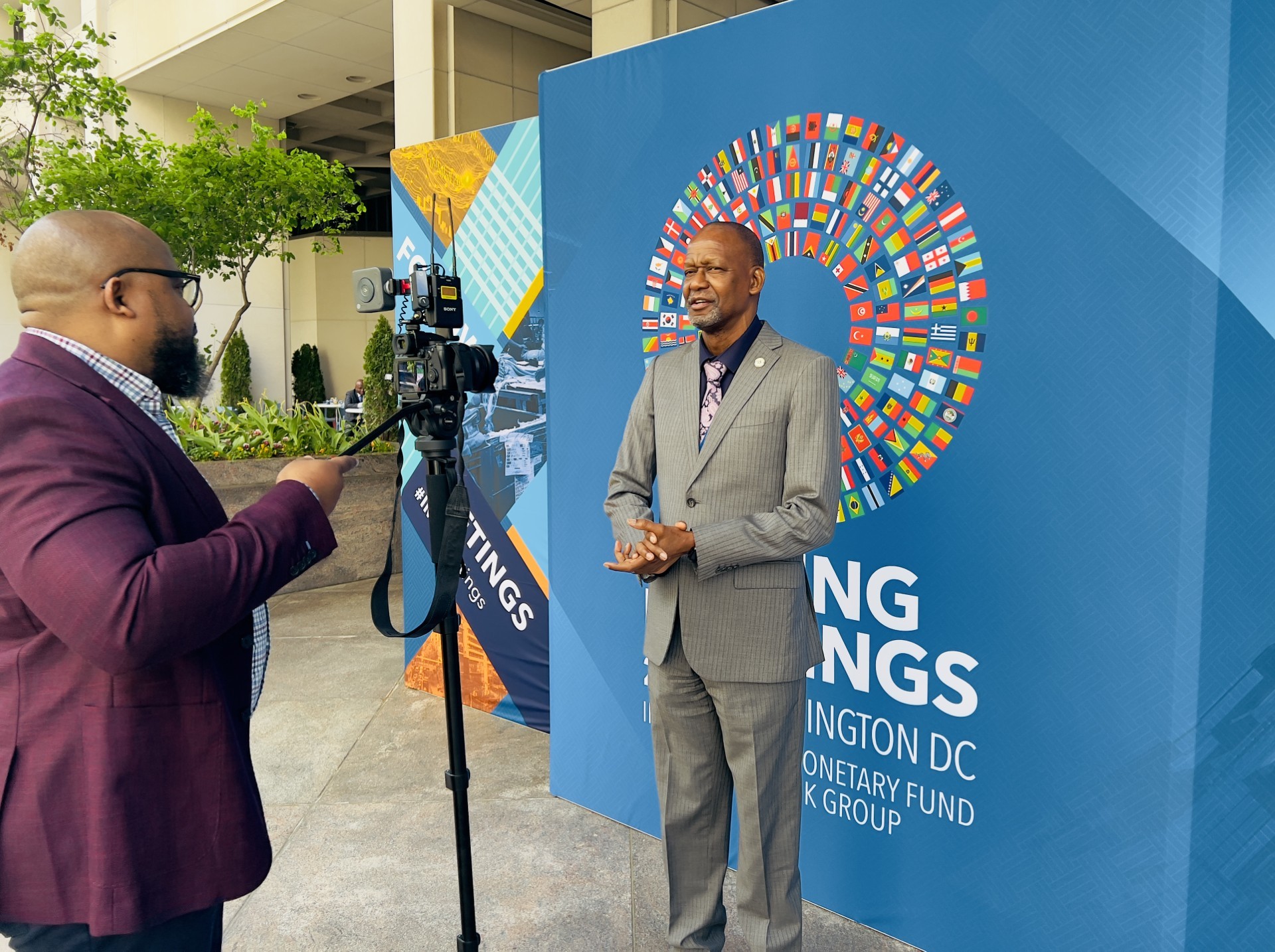
The Executive Secretary of the Southern African Development Community (SADC), His Excellency Mr. Elias Magosi, advanced the region’s economic priorities during the International Monetary Fund (IMF) and World Bank Group Spring Meetings held from April 13–18, 2026, in Washington, D.C., United States of America. The Spring Meetings provided a strategic platform for SADC to elevate its visibility, secure commitments, and strengthen partnerships with global institutions. H.E. Magosi’s engagements underscored the importance of ensuring Southern Africa’s voice is heard in shaping international economic governance.
The engagements began on April 13, when H.E. Magosi participated in a roundtable convened by Dr. Ndiame Diop, World Bank Vice President for Eastern and Southern Africa, alongside representatives of Africa’s Regional Economic Communities (RECs). The meeting examined the impact of global crises on trade and stability and highlighted the importance of structured engagement between the World Bank and RECs to strengthen resilience and safeguard supply chains.
On April 14, the SADC Secretariat and the World Bank reaffirmed their strong partnership during a high-level meeting at the Bank’s headquarters. The Secretariat currently manages a programme portfolio valued at US$31,566,210 across sectors including statistics, climate resilience, groundwater management, and energy. The World Bank has committed US$292 million for the Zambian portion of the Zambia–Tanzania Interconnector, a project designed to link the Southern African Power Pool (SAPP) and Eastern Africa Power Pool (EAPP), enabling inter-regional power trade and increasing transmission capacity in Northern Zambia. Another targeted project is the Angola–Namibia Interconnector, which will enhance the capacity of the regional pool. The Bank is engaging with both the Governments of Angola and Namibia on the financing deal.
The Secretariat also expressed appreciation for the Bank’s support towards Phase Two of the SADC Regional Energy Transmission, Trade, and Decarbonization (RETRADE) Programme, which totals US$12 million and runs until December 2028. This phase provides technical assistance to the Southern African Power Pool (SAPP), SADC’s Subsidiarity Organisation based in Harare, Zimbabwe. H.E. Magosi called for the swift conclusion of negotiations for Phase Three, financing the Angola–Namibia Interconnector, and highlighted progress on the North–South Integrated Economic Corridor.
Later that day, H.E. Magosi delivered a strong call to action during a World Bank Group roundtable with African ministers, private sector leaders, and AU officials. He urged accelerated delivery of Agenda 2063 priorities, the African Continental Free Trade Area (AfCFTA), the Single African Air Transport Market (SAATM), and the Free Movement of Persons, emphasising that Africa’s challenge is no longer agreeing on integration but delivering it in a coordinated and impactful way. He also joined discussions on the transformation of capital markets driven by new technologies, reaffirming SADC’s commitment to strengthening regulatory frameworks and supporting innovation that contributes to resilient, inclusive, and well-regulated financial markets.
On April 15, H.E. Magosi met Dr. Ruth Kattumuri of the Commonwealth Secretariat to explore cooperation in trade, investment, youth empowerment, public health, and resilience building. The meeting highlighted opportunities for small states that are members of both SADC and the Commonwealth, with emphasis on access to development finance and climate resilience. He also held a courtesy meeting with Dr. Boniface Njenga, Deputy Director for Africa at the Bill Gates Foundation. Discussions focused on understanding SADC’s health sector priorities amid reductions in Official Development Assistance and supporting reforms through the SADC Pool Procurement Service and health financing initiatives. H.E. Magosi highlighted the importance of sustaining gains in the fight against HIV, Tuberculosis, and malaria, while accelerating regional manufacturing and self-reliance. Dr. Njenga commended SADC’s leadership in implementing the African Leadership Meeting Declaration on Health Financing and pledged continued support for the upcoming Joint Meeting of Ministers of Health and Ministers of Finance.
On April 16, the Executive Secretary met with SADC Ambassadors and Heads of Mission in Washington, D.C., hosted at the Embassy of South Africa, as the current chair of SADC. The meeting reaffirmed the importance of close collaboration between the Secretariat and SADC Missions. Ambassadors pledged to intensify engagement with international financial institutions and policymakers to advance regional priorities amid global economic uncertainty.
During the week, H.E. Magosi also met with Mr. Jason Grubb, Acting Deputy Assistant Secretary for African Affairs at the U.S. Department of State, to reinforce cooperation in support of regional integration, stability, and sustainable development. Discussions addressed priority sectors and visa policies affecting SADC Member States. On the margins of the Spring Meetings, H.E. Magosi met Zimbabwe’s Minister of Finance, Professor Mthuli Ncube, who updated the Secretariat on the progress of Zimbabwe’s Arrears Clearance and Debt Resolution Roadmap. He commended Zimbabwe’s reform momentum and urged international partners to match the country’s efforts with coordinated support. Zimbabwe has achieved key milestones, including a Staff-Level Agreement on a10-month IMF Staff Monitored Programme and the establishment of a Debt Resolution Sector Working Group. H.E. Magosi emphasised that timely arrears clearance is essential for Zimbabwe to regain access to concessional finance and avoid regional spillover effects on investment flows and financial stability.
H.E. Magosi also attended several IMF and World Bank sessions, including Knowledge Cafés and presentations on the Global Financial Stability Report and the global economic outlook. The 2026 World Economic Outlook signaled that the global economy is entering a more fragile phase, shaped by tighter financial conditions, geopolitical tensions, climate shocks, and elevated debt levels. For SADC Member States, the message was clear: navigating uncertainty requires coordinated, credible, and forward-looking policies that anchor macroeconomic stability, rebuild fiscal space, deepen regional integration through the RISDP 2020–2030 and AfCFTA, safeguard financial stability, protect social spending, and invest in productivity, human capital, and climate resilience to secure inclusive and sustainable growth.
SADC’s presence at the Spring Meetings elevated the region’s visibility, secured commitments for technical and financial support, and strengthened partnerships with global institutions. These engagements reinforced SADC’s role in shaping global economic policy while advancing its regional integration and development agenda. The SADC Executive Secretary was accompanied by Dr. Mario Lironel, Senior Finance and Investment Officer; Mr. Jagai Deedpchandsingh, Senior Programme Officer – Statistics; Dr. Lamboly Kumboneki, Senior Programme Officer – HIV/AIDS; and Ms. Barbara Lopi, Head of Communication and Public Relations.


